


This article, dedicated to the beginners, provides a number of elements to help you recognize some dangerous situations and gives some hints.
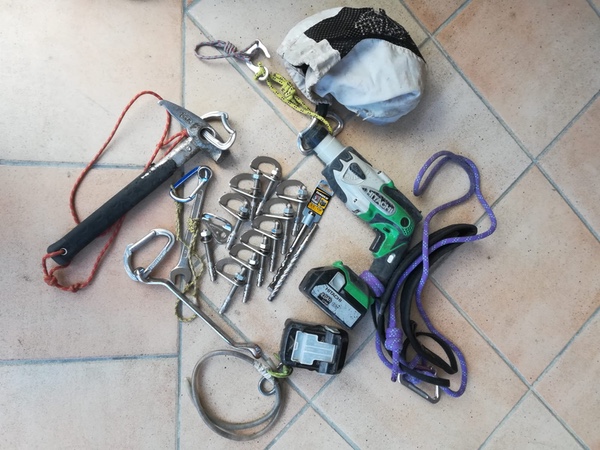
Route setter gear
Gianluca Di Benedetto
Gianluca Di Benedetto
The expansion bolt [commonly called "bolt", or, in some countries "fix", or "spit", nde] used in conjunction with the hanger nowadays is a kind of fetish, capable of significantly raising safety levels, and it's definitely the most used anchor in the sport climbing field.
This is mainly due to a number of indisputable benefits, among which the ease of installation and the quite reasonable cost.
Last but not least, there is an irrefutable technical element: if correctly installed, it could support the weight of a car!
But not all that glitters is gold: we are examining a number of dangerous situations and suggesting some countermeasures.
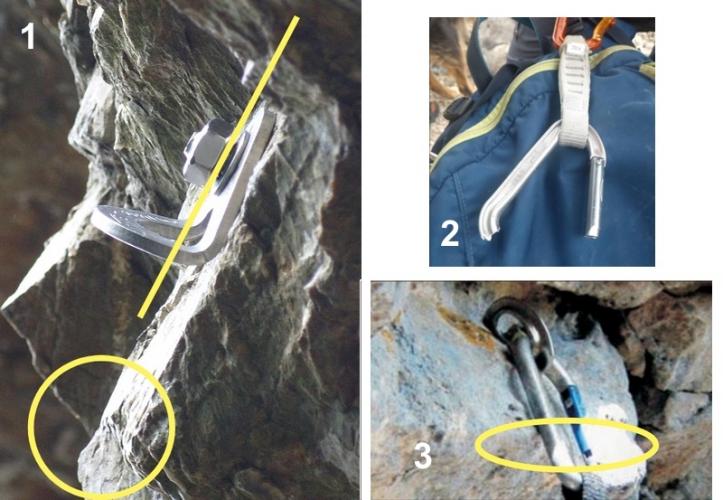
1) Leverage effect
2) Broken Carabiner
3) Carabiner leverage across the edge
Gianluca Di Benedetto
2) Broken Carabiner
3) Carabiner leverage across the edge
Gianluca Di Benedetto
Leverage Effect
When the expansion bolt is hammered near some edges or protrusions (Fig. 1), it can generate a leverage effect on the carabiner.
Potential Consequences: the rupture of the carabiner (Fig. 2).
Suggestions: use some slings to outdistance the carabiner from the protrusion or the edge that generates the leverage effect. Wear the helmet.
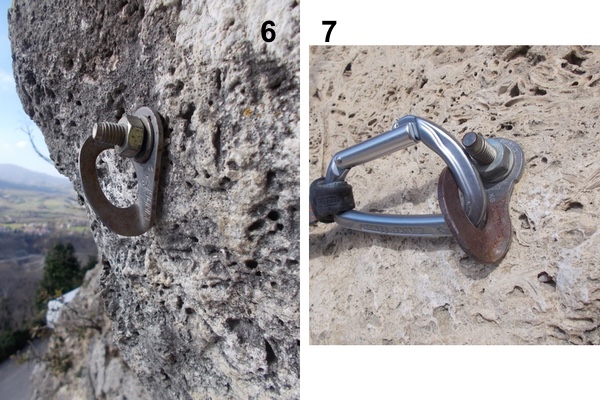
Incorrectly Installed Fix
When the fix has been not right-angled with the rock wall, or the "bolt" is not completely entered into the rock (Fig. 6), it could break.
Potential Consequences: A not correctly set fix not only could break, but its protruding part could generate a leverage effect on the carabiner. Moreover, such protruding part could hurt the climber in case of fall.
7) Carabiner leverage across the bolt protrusion
Suggestions: Don't use only one anchor for lowering down, or for locking. Wear the helmet.
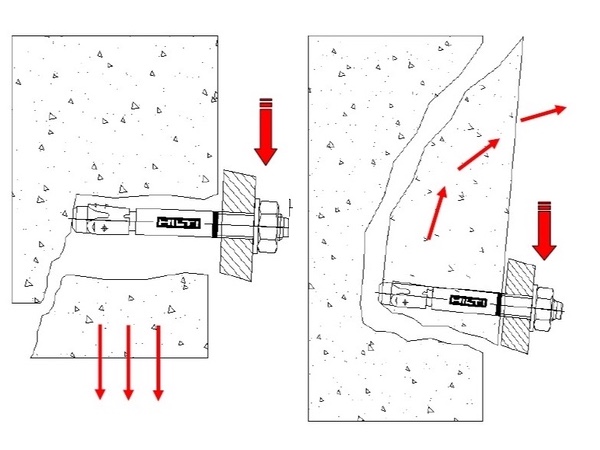
Fix troppo vicino a fessure o fratturazioni
Dal Web
Dal Web
Fix too close to cracks or edges
A fix has to be set at least 20 cm from any kind of edge. When the bolt has been hammered in a chossy rock, or too close to a crack, or a hole, the part of the rock in which it is hammered could crumble
Potential Consequences: The cracked or chossy rock in which the bolt has been hammered could crumble, with severe consequences for the climber, for his belayer and for other people at the bottom of the route.
Hints: Don't use only one bolt to lowering down, or to locking your self. Wear the helmet.
The expansion bolt is not suitable for the rock
Some kind of rocks mismatch with the expansion bolts: "too soft" rock, or "too fragile" conglomerate, for example (such issue cannot bee adequately debated here).
Potential Consequences: Il fix potrebbe non tirare, si muove ("balla") nella roccia, e, a lungo andare potrebbe fuoriuscire dalla parete.
Hints: Don't use only one bolt to lowering down, or to locking your self. Wear the helmet.
Rusty Fix
When a bolt is set in an aggressive environment, it could be subject to some corrosion phenomena (not always visible, as in Fig. 4!).
Potential Consequences: The anchor could break.
Hints: Don't use only one bolt to lowering down, or to locking your self. Wear the helmet.
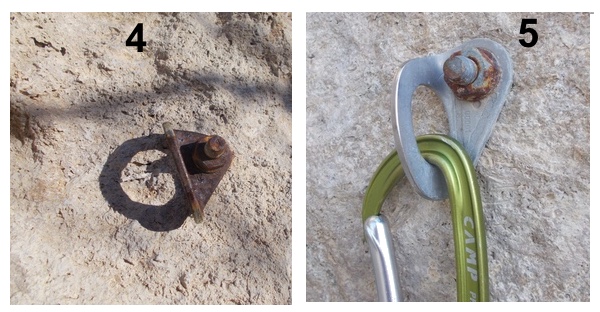
5) Stainless steel hanger screwed in a simply steel bolt: the bolt is getting rusty
Bolt and hanger made from different materials
If the bolt is made from a material which is different from that used for its hanger, some galvanic currents are triggered and, as a result, the less nobles metal corrodes. In Fig. 5 you can see an example of this situation: a stainless steel hanger, screwed on a simply steel bolt.
Potential Consequences: The anchor could break.
Hints: Don't use only one bolt to lowering down, or to locking your self. Wear the helmet.
continues...
Leave a comment