


A semi-lucid journey through the maze of sport climbing guidebooks in the age of artificial intelligence.
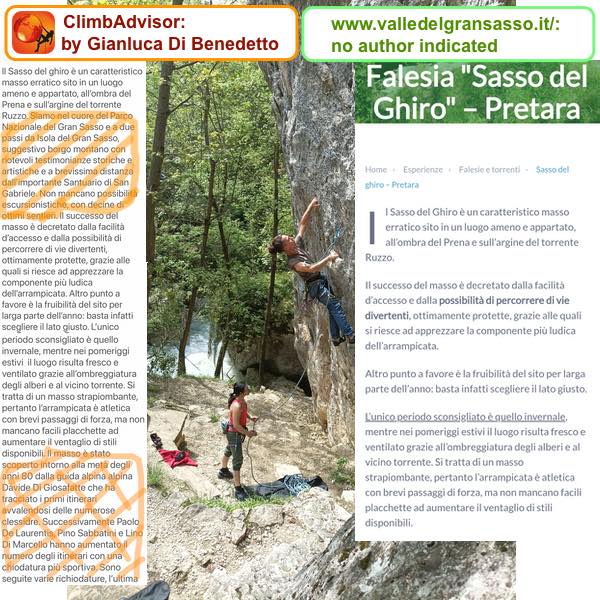
Comparison between Gianluca Di Benedetto’s text for ClimbAdvisor
and the one published by Valle del Gran Sasso
Substantial passages are reproduced verbatim, including the same typo
The second text omits the historical and environmental sections.
and the one published by Valle del Gran Sasso
Substantial passages are reproduced verbatim, including the same typo
The second text omits the historical and environmental sections.
“All that we see or seem
Is but a dream within a dream.”
E. A. Poe
A few nights ago, as often happens when one is driven by the unfamiliar and suspicious fervour of nocturnal illusions, I was pointlessly exhausting all my energy in a particularly vivid dream. I was racking my brains over some sort of article and had managed, through an elaborate series of metaphors and without directly mentioning people or events, to give a credible account of some of the less pleasant aspects I had encountered during my life as a climber. Nothing could be more inevitable — and perhaps more amusing, at least to an outside observer — than stumbling upon the many contradictions that lie at the heart of this activity, capable of trapping the individual in the “grotesque limbo of their own idiosyncrasies.”
In a society that is utterly exhausting and alienating, and that seems long ago to have drifted away from the cycles of nature and from a simpler, less neurotic way of life, a return to “Nature” could only represent an escape, an aspiration, perhaps even a lifeline. And yet, in an age obsessed with performance and virtuosity, even this attempt to reclaim “Paradise Lost” has proved suspect, triggering a series of bitter conflicts.
My thoughts turned first to the delicate subject of climbing guidebooks. In the age of artificial intelligence, there is a serious issue concerning the protection of content created by individual authors. Some might argue that good old-fashioned “copy and paste” was already a fairly widespread practice, carried out with varying degrees of awareness and legitimacy. But today even the source itself fades into the background: a single click is enough to produce an account extracted from various websites which, in turn, have drawn on other databases, in a hall of mirrors where the original author disappears.
It is a sleight of hand that, moreover, rarely produces anything genuinely useful or reliable for those seeking information. Just try asking AI for information about various crags and the results are often bewildering, ranging from completely false to incomplete information: the natural consequence of training based on second- or third-hand material cascading freely across the web. In the end, it is not only the author who disappears: the quality of the information itself risks being lost, with all the dangers that entails.
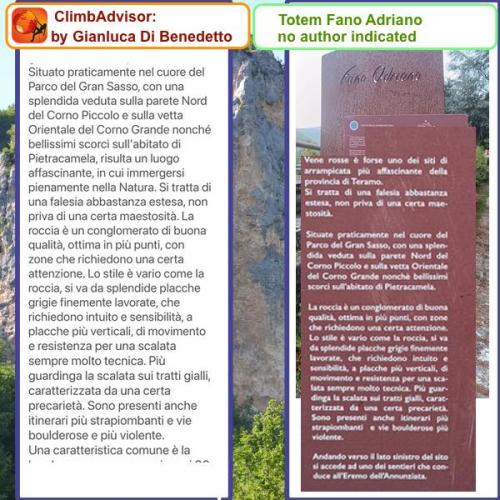
Comparison between Gianluca Di Benedetto’s text for ClimbAdvisor
and the information panel in Fano Adriano, with no author indicated.
The panel contains original material alongside
passages taken from the description published on ClimbAdvisor.
and the information panel in Fano Adriano, with no author indicated.
The panel contains original material alongside
passages taken from the description published on ClimbAdvisor.
It is true: we ourselves are training these models and soon, who knows, the information may become flawless. Perhaps a virtual voice will guide us right to the foot of the crag, or suggest the best beta for getting through a route’s crux, complete with all the encouragement we could wish for — perhaps even assisted by a drone that will have our chosen line already set up and waiting for us!
For the time being, however, this is the reality, and these considerations alone would be enough to justify a preference for guidebooks in which the bolter or the person responsible for a particular climbing area is also entrusted with writing its description, as is the case with the ClimbAdvisor app. An approach that stands in stark contrast to other publications, inclined to devise slogans about respecting bolters and locals only, alas, to spectacularly contradict them in practice.
Imagine our surprise at recognising substantial passages from ClimbAdvisor guidebooks reproduced verbatim on various websites, in printed guidebooks and, in one case, even on a metal information panel installed beside a historic fountain — a project commissioned, and undoubtedly paid for, by a mountain municipality that will certainly be familiar to climbers. All this without so much as a word to the author or any acknowledgement of the source!
So what exactly does it take to write a climbing guidebook, avoid a whole series of unpleasant complications, and add just a “pinch” of self-promotion?
The recipe is disarmingly simple: take an association of intrepid explorers of the peaks and establish it in a place where the greatest elevation gain is provided by the local flyover. Once that is done, claim jurisdiction over a territory vast enough to make the Western Roman Empire pale by comparison.
And now the real magic begins: the noble art of “vertical colonisation”. Create a series of phantom crags, with approaches requiring teleportation and bolting that seems ready to defy all logic even before it defies gravity. And why stop there when you can venture into creative publishing as well? Simply find a rich, meticulously curated source — perhaps a reference app where someone has patiently archived years of fieldwork — and “draw inspiration” from it with impeccable timing!
Meanwhile, on the one hand, the names of bolters who worked in the area for years, creating some of its most popular crags, mysteriously vanish from the descriptions; on the other, paradoxically, ample space is devoted to the memory of those who are no longer with us, within a narrative that, to this writer, appears decidedly self-celebratory.
Et voilà: the job is more or less done, and everything is ready for the next great feat of social climbing!
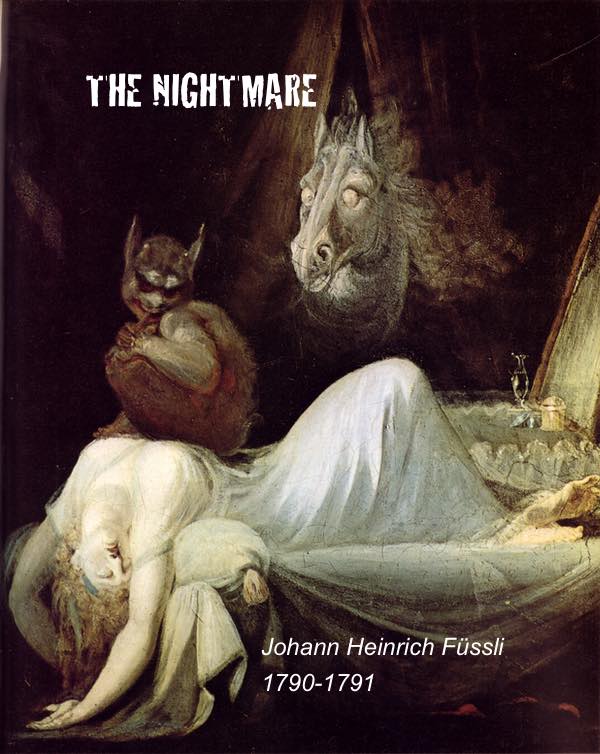
The Nightmare (1790-1791)
Johann Heinrich Füssli
Johann Heinrich Füssli
But woe betide anyone who points out such trifles: anyone who dares to voice even the slightest doubt is immediately branded an envious defeatist, the perennial malcontent who, on principle, opposes these titanic and commendable works of philanthropy!
With all romanticism now a thing of the past, the path ahead is inevitably clear: never display one’s “art” or passion light-heartedly; better to rely on cold calculation and colonise the field only when one stands on solid ground and has strength in numbers.
After all, history is not written by those who make it, but by those who have more time to devote to public relations.
That, more or less, was my dream, but its outlines are so blurred... After all, to quote Shakespeare almost word for word: “We are such stuff as dreams are made on...” — stuff far too insubstantial for the real world, and so the details fade away...
Or perhaps it was the fright of a hypnagogic hallucination, that moment before sleep when reality begins to crack, conjuring up the shadow of a nightmare with indistinct contours?
Does the sleep of reason produce monsters?
Or is it, rather, the undeniable disillusionment of reality?
Leave a comment